3 Ways AI Will Change Virtual World Socializing
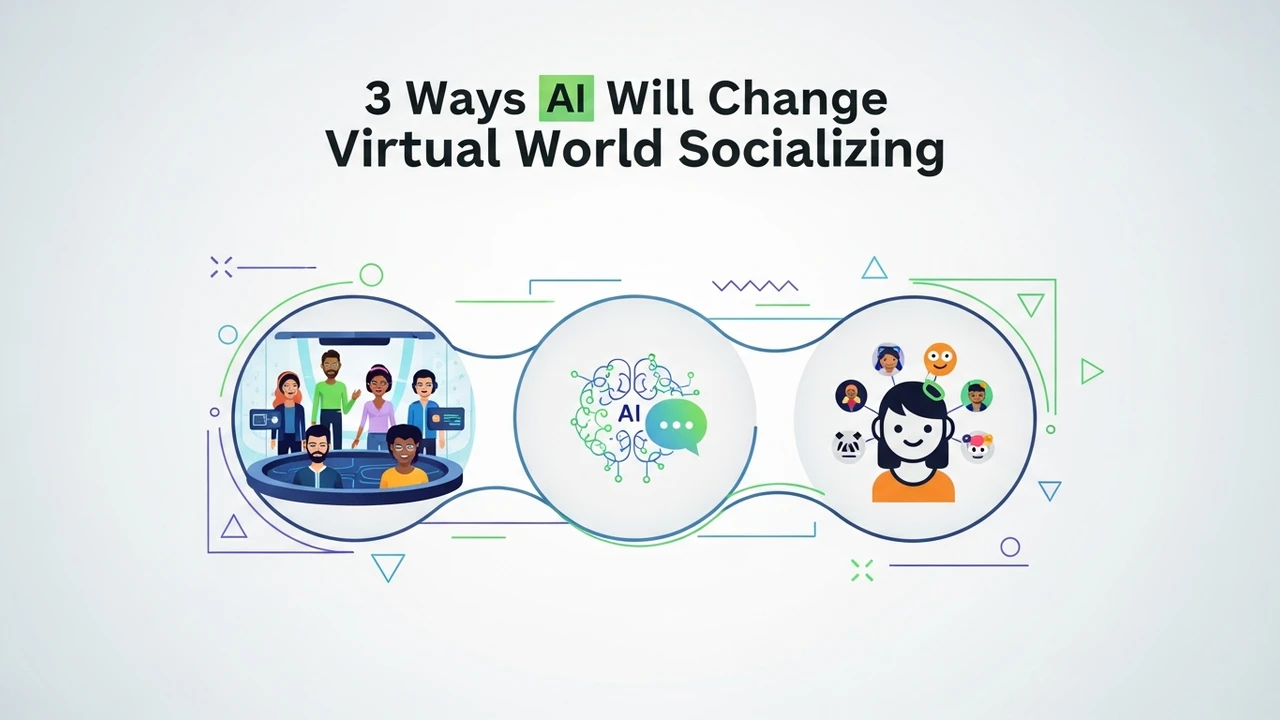
Explore the 3 ways AI will revolutionize how we interact and socialize within virtual world environments.
3 Ways AI Will Change Virtual World Socializing
Explore the 3 ways AI will revolutionize how we interact and socialize within virtual world environments.
Have you ever felt like your virtual world interactions were a bit... stiff? You walk up to an avatar, type a message, and wait for a canned response. It’s functional, sure, but it’s not exactly human. That is all changing fast. Artificial Intelligence is currently tearing down the walls between static digital avatars and truly dynamic, social experiences. We are moving away from scripted interactions toward a future where virtual worlds feel as alive as a crowded coffee shop in downtown Singapore or a bustling tech hub in San Francisco.
AI Driven Dynamic NPC Conversations and Social Depth
The first major shift is how we talk to the world around us. We are moving past the era of 'press F to talk' and into the era of natural language processing. Imagine walking into a virtual tavern in a fantasy game and having a deep, philosophical conversation with a bartender who remembers your previous visits, knows your reputation, and reacts to your tone of voice. This isn't just about better dialogue trees; it's about Large Language Models (LLMs) integrated directly into the game engine.
Products like Inworld AI are leading this charge. They allow developers to give NPCs 'brains' that can reason, remember, and express emotions. Unlike traditional systems, Inworld’s characters don't just recite lines; they generate responses on the fly based on the context of the world. Another player in this space is Convai, which focuses on real-time conversational AI for virtual worlds, making it incredibly easy to plug into Unity or Unreal Engine. If you are a developer, you are looking at a pricing model that usually starts with a free tier for testing, scaling up to enterprise costs based on API calls, often ranging from $50 to several hundred dollars per month depending on the scale of your world.
Hyper Realistic Digital Human Avatars for Social Presence
Socializing isn't just about what you say; it's about how you look and move. The 'uncanny valley' has been a massive hurdle for virtual social platforms, but AI-driven digital human technology is bridging that gap. When you see a digital human that mimics your actual facial expressions in real-time, the sense of 'presence' skyrockets. This is crucial for the US and Southeast Asian markets, where remote collaboration and social gaming are booming.
Take Ready Player Me, which has become the standard for cross-platform avatars. They are increasingly using AI to generate high-fidelity textures and clothing from simple inputs. For those needing more realism, MetaHuman Creator by Epic Games remains the gold standard. It’s free to use if you are working within the Unreal Engine ecosystem, which is a massive win for indie creators. If you need something more plug-and-play for video calls or social apps, Animaze is a fantastic tool that uses AI to map your webcam feed to a 3D avatar with incredible precision. Animaze offers a subscription model around $10-$20 per month for premium features, making it accessible for individual creators.
AI Powered Social Matching and Community Management
The third way AI is changing things is behind the scenes. How do you find your 'tribe' in a virtual world with millions of users? AI is now being used to analyze social patterns, interests, and playstyles to match people together. It’s like a dating app algorithm, but for finding your next raid group or virtual book club. This is vital for keeping communities healthy and preventing toxicity.
Platforms like Modulate are using AI to detect and mitigate toxic behavior in voice chat in real-time, which is a game-changer for social safety. Their product, ToxMod, is essentially a proactive moderator that understands context, not just keywords. It’s a must-have for any large-scale virtual world. Pricing for these enterprise-grade safety tools is usually custom-quoted, but the value proposition is clear: a safer community is a more profitable and sustainable one. By automating the 'policing' of social spaces, developers can focus on building better features rather than constantly fighting fires in the chat logs.
Comparing the Tech Stack for Your Virtual World
When you look at these tools, it’s easy to get overwhelmed. If you are building a social-heavy platform, you need to prioritize. For conversational depth, Inworld AI is currently the most robust, though it requires more technical setup than Convai. For visual presence, if you are on Unreal, stick with MetaHuman. If you are building for mobile or web, Ready Player Me is the clear winner due to its lightweight nature and massive library of assets. The cost of entry is lower than ever, but the complexity of integrating these AI layers is where the real work lies. Whether you are targeting the high-end gaming market in the US or the mobile-first social landscape in Southeast Asia, these AI tools are no longer optional—they are the foundation of the next generation of digital social interaction.
:max_bytes(150000):strip_icc()/277019-baked-pork-chops-with-cream-of-mushroom-soup-DDMFS-beauty-4x3-BG-7505-5762b731cf30447d9cbbbbbf387beafa.jpg)