3 Future Roles for Digital Humans in Society
Explore the 3 potential future roles for digital humans in education, healthcare, and social interaction.
3 Future Roles for Digital Humans in Society
Explore the 3 potential future roles for digital humans in education, healthcare, and social interaction.
You have probably noticed that digital humans are no longer just pixelated characters in video games. They are becoming increasingly sophisticated, powered by advanced AI that allows them to speak, gesture, and even show empathy. As we look toward the next decade, these virtual beings are poised to integrate into our daily lives in ways that might seem like science fiction today. Let’s dive into how these digital entities are going to reshape our society.
Digital Humans Transforming Personalized Education
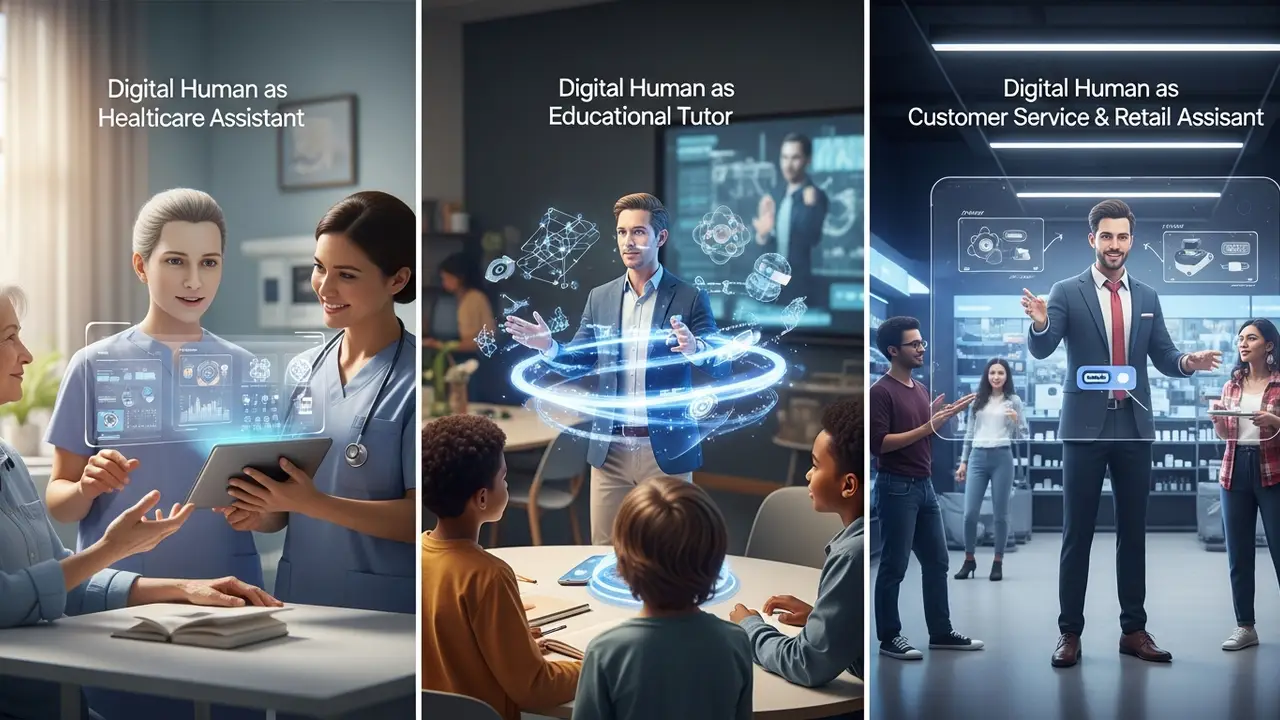
Imagine a classroom where every student has a dedicated AI tutor that never gets tired, never loses patience, and adapts perfectly to their learning style. That is the promise of digital humans in education. Unlike static video lectures, these AI avatars can engage in real-time dialogue, answer complex questions, and provide immediate feedback. Platforms like Soul Machines are already experimenting with this, creating avatars that can read a student's facial expressions to see if they are confused or bored. If the student looks puzzled, the digital human can automatically adjust its explanation, perhaps using a different analogy or breaking the concept down into simpler steps. This level of personalization is something a single human teacher in a room of thirty students simply cannot provide. It is not about replacing teachers; it is about giving them a super-powered assistant that handles the repetitive, foundational work while the human teacher focuses on mentorship and complex problem-solving.
Revolutionizing Healthcare with AI Virtual Assistants
The healthcare sector is perhaps the most critical area where digital humans will make a massive impact. We are talking about 24/7 virtual health companions that can monitor your vitals, remind you to take medication, and even conduct initial mental health screenings. Companies like Uneeq are leading the charge here, developing digital humans that can act as empathetic interfaces for patients. Think about an elderly person living alone; a digital human on their tablet could check in on them, ask how they are feeling, and detect subtle changes in their voice or speech patterns that might indicate a health issue. These avatars are designed to be non-judgmental and always available, which is a huge benefit for patients dealing with anxiety or depression who might feel uncomfortable talking to a human doctor. They can bridge the gap between clinical visits, ensuring that patients feel supported and monitored without the need for constant, expensive human intervention.
Redefining Social Interaction and Virtual Companionship
Social interaction is the third pillar where digital humans will fundamentally change our world. We are moving toward a future where digital companions are a standard part of our digital experience. Whether it is a virtual influencer on social media or a personalized AI friend in a virtual world, these entities are becoming more relatable. Take a look at platforms like Ready Player Me or the avatars used in VRChat; they are becoming the primary way we express ourselves online. In the future, these digital humans will act as our proxies in the metaverse, attending meetings for us, socializing in virtual spaces, or even acting as personal shoppers. They will have their own personalities, memories, and quirks, making them feel like genuine companions rather than just tools. This shift will change how we form relationships, how we consume content, and how we perceive the boundary between the physical and digital worlds.
Comparing Top Digital Human Platforms
If you are looking to get started with this technology, you need to know which tools are worth your time. Let’s break down a few key players. First, there is Synthesia, which is fantastic for corporate training and marketing. It is incredibly easy to use—you just type your text, and the avatar speaks it with perfect lip-syncing. It is priced for businesses, usually starting around $30 per month for basic plans. Then you have Soul Machines, which is on the higher end of the spectrum. Their digital humans are designed for high-end, interactive customer service and feature advanced emotional intelligence. These are enterprise-grade solutions, so you are looking at custom pricing that can reach thousands of dollars depending on the complexity of the integration. Finally, there is D-ID, which is great for turning static photos into talking avatars. It is very affordable and accessible for individual creators, with a free trial and subscription tiers starting as low as $6 per month. Each of these serves a different purpose, so your choice really depends on whether you need a simple presenter or a fully interactive, emotionally aware companion.
Practical Use Cases and Implementation
So, how do you actually use these? For businesses, the most common use case is customer support. Instead of a chatbot that just gives you links to FAQs, a digital human can walk you through the process of setting up a new device or troubleshooting a billing issue. It feels like a real conversation. In the creative industry, filmmakers are using digital humans to create background characters or even lead actors in scenes that would be too dangerous or expensive to film in real life. For developers, the key is integration. Most of these platforms offer APIs that allow you to plug their digital humans into your own apps, websites, or virtual world environments. You can control their movements, their voice, and their responses, giving you total creative freedom. The barrier to entry is dropping every day, and you don't need a massive budget to start experimenting with these tools. Whether you are a student, a developer, or a business owner, the tools are there, and the potential is limited only by your imagination.
:max_bytes(150000):strip_icc()/277019-baked-pork-chops-with-cream-of-mushroom-soup-DDMFS-beauty-4x3-BG-7505-5762b731cf30447d9cbbbbbf387beafa.jpg)